Following the Singapore Budget 2026 announcement, we held a breakfast briefing “2026 Singapore: Budget impacts and market outlooks” with the Singapore Economic Development Board (EDB). Part of the event included a panel discussion on how markets across the globe view Singapore.
Moderated by Leslie Sarma, Co-Founder of Collaborative Working Solutions and Board Member of the British Tech Advisors (B.TA), the panel featured:
- Darius Gaidys, Ambassador of Lithuania to Singapore, Malaysia, Vietnam, Thailand, Indonesia and the Association of Southeast Asian Nations (ASEAN)
- David Ng, Senior Investment Director at the Australian Trade and Investment Commission (Austrade)
- Erika Sirimanne, Head of Business Development (Tech) at the New Zealand Trade and Enterprise (NZTE)
- Federico Donato, Managing Partner at MCG Partners and Past President of EuroCham
- Dr Hsien-Hsien Lei, Chief Executive Officer (CEO) of The American Chamber of Commerce in Singapore (AmCham Singapore)
- Niall Ahern, Country Director at the British High Commission (UK in Singapore)
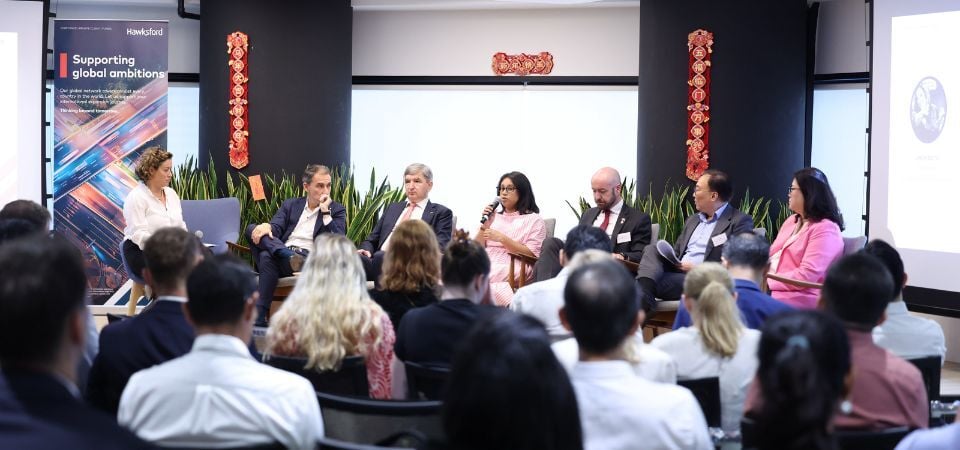
From left to right: Leslie Sarma, Federico Donato, Darius Gaidys, Erika Sirimanne, Niall Ahern, David Ng, Dr Hsien-Hsien Lei
In this article, we share insights from panellists that are actively supporting investors and companies expanding from their home markets to Singapore.
How other markets perceive Singapore
For many companies operating across borders, geopolitical tensions, supply-chain shifts and economic uncertainty have created new pressures.
As the global commercial landscape becomes harder to navigate, many are placing greater consideration on where they position themselves, with resilience and long-term planning in mind. In this aspect, Singapore continues to be a safe and welcoming place for businesses.
Niall Ahern, Country Director at the British High Commission (UK in Singapore), observed: “Despite all that has been going on over the last 12 months, particularly around tariffs, we’ve noticed our trade investment figures here have only gone up. A big part of that comes down to the wider range of pro-business measures that Singapore has provided, which has given companies the confidence to invest and grow.”
In many ways, Singapore is aligning itself with other advanced economies, sharpening its focus on the industries that are likely to shape future growth.
David Ng, Senior Investment Director in Austrade, shared about Australia’s national strategy “Invested: Australia's Southeast Asia Economic Strategy to 2040” as an example where the country is focusing on sectors such as manufacturing, healthcare, energy transition and digital infrastructure.
He elaborated, “There are quite a few overlaps when it comes to what Singapore is focusing on, what it wants to develop and how Australia sees itself playing in this region. More than that, Singapore stands out as far more than a business destination. It is a deeply connected ecosystem, with the density of partners, talent and capital that can give many a strong platform for growth.”
Artificial intelligence as a major focus for Singapore
It is clear from the recent Budget announcement that Singapore is focusing on artificial intelligence (AI), positioning it as a key driver of productivity and future economic growth. The government is encouraging individuals and businesses to experiment with and adopt AI, particularly in manufacturing, connectivity, finance and healthcare. National AI missions will be launched to support these sectors.
Federico Donato, Managing Partner at MCG Partners and Past President of EuroCham, remarked, “I think all of us are thinking, what does it mean for me? What does it mean for my job? Am I losing my job? Am I getting a better job or am I helping my company more? But this topic has been with us for decades and now, we are just increasingly seeing its capabilities.”
“There are many AI incentives and investments happening in Singapore,” Dr Hsien-Hsien – CEO of AmCham Singapore – added.
“The challenge isn’t what we’re going to be able to create more of. It’s how to use AI and implement it for the security, safety and prosperity of Singapore and all the businesses that choose to establish themselves here,” she shared.
Dr Hsien-Hsien elaborated, “Singapore has also been able to become a leader in AI because of the kind of companies, American businesses included, that have chosen to make additional investments in Singapore. Collaboration is important and continues to proliferate.”
How the country continues to support internationalisation
Against this backdrop, Singapore is building on the support available to businesses seeking growth. These range from tax relief to grants and innovation funding to help companies through using the country as a launchpad for regional and international expansion.
Ambassador of Lithuania, Darius Gaidys, shared, “When investors from my country consider Singapore, they look at the taxation system as well as the legal system. They admire the stability here."
He continued, “This year’s Budget continues to address the practical aspects of opening a business such as tax incentives, grants and support schemes.”
Federico also added, “I think Singapore has all the means to keep doing well and the Budget is very clear that it is a healthy situation.”
“As a matter of fact, I think the connectivity in the region is becoming more advanced. The Johor-Singapore Special Economic Zone (JS-SEZ), in a way, tries to address the scarcity of land in Singapore, for example.”
The challenges to navigate
If there is a point of concern for companies, as Dr Hsien-Hsien mentioned, it’ll be that Singapore is small and deeply dependent on trade.
“During the pandemic, when borders elsewhere were closing, many wondered whether the country could keep its supply lines open and sustain the movement of goods and people,” she explained.
She highlighted, “On that front, Singapore has demonstrated a strong will to businesses around the world that it is open for business, even in tough times.”
Erika Sirimanne, Head of Business Development (Tech) at NZTE, also touched on some of the challenges that start-ups and scale-ups face when expanding here. She shared, “I think the motivation for coming here depends on the sector in which you’re in.”
“I’ve been here in Singapore for about ten years now, so I’ve had an opportunity to see how things have changed. The focus on different sectors has changed over that time as well,” she explained.
Erika noted, “It’s not necessarily Singapore-specific but the challenge is that companies underestimate what it really takes to enter and then grow in a market. How much money am I going to need to set up an entity, hire staff and then actually build relationships here to grow? I think that’s a consistent challenge.”
Supporting companies entering Singapore in 2026-27
Companies more often see Singapore as a base from which to engage other ASEAN markets. Singapore is increasingly reinforcing this role by focusing on internationalisation, encouraging companies to look beyond the domestic market and explore regional and global opportunities.
Our team guides companies entering the market and structuring their presence for wider regional growth. If you’re assessing how Singapore could support your expansion plans, our experts are available to discuss the steps involved and the considerations most relevant to your business.
For more information, please get in touch. You may also subscribe to our newsletter for regular insights and updates on upcoming events.

Speak to our experts today
Get in touch to find out how our Corporate team can support you with your business needs.